


 Magical Urbanism, a website about urbanization, design and social change, is maintained by Mike Ernst. I'm an urban planner and designer based in New York City. I graduated from the
 The Shrinking, Adapting City of Detroit
Even in the sagging economy of the Great Recession, Detroit stands alone for the staggering amount of media attention it’s received because of its economic woes. While cities across the globe struggle with how to accommodate an urban planet, Detroit has become a shrinking metropolis. Following the flight of its industrial base, the city’s population has declined to half of what it was in the 1950′s. Too few jobs has meant too few people to maintain what was once deemed the “Paris of the Midwest.”
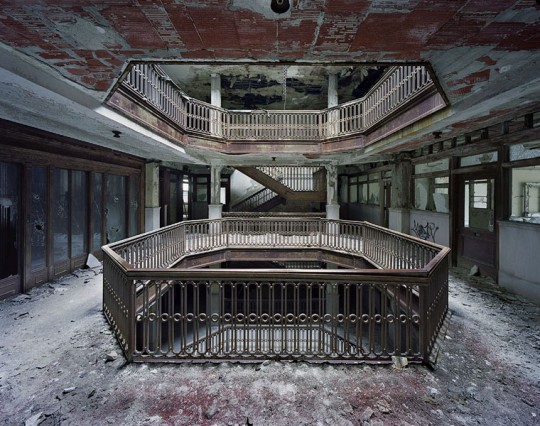
The resulting glut of abandoned homes, factories, theaters and train stations has been well documents by a number of activists and artists. Urban historian Camilo José Vergara, who has documented the city’s decay since the 1970′s, once proposed turning the ruins into “a grand national historic park of play and wonder, an urban Monument Valley.”
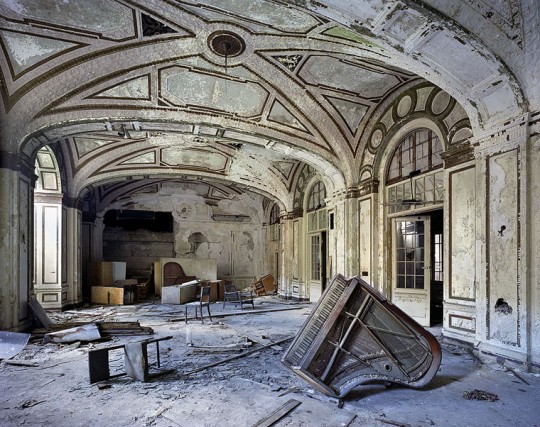
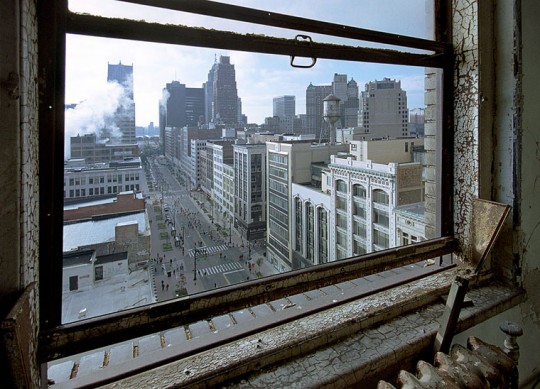
Yves Marchand and Romain Meffre began documenting the city in 2005; their images are used throughout this post.
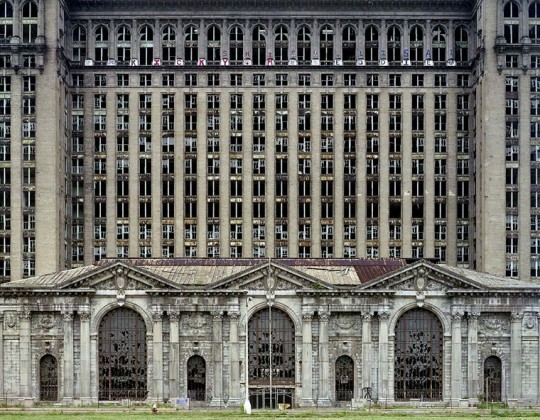
Their take on the city is quite bleak and is reflected in their imagery. From the artists’ website:
Detroit, industrial capital of the XXth Century, played a fundamental role shaping the modern world. The logic that created the city also destroyed it.

Nowadays, unlike anywhere else, the city’s ruins are not isolated details in the urban environment. They have become a natural component of the landscape. Detroit presents all archetypal buildings of an American city in a state of mummification. Its splendid decaying monuments are, no less than the Pyramids of Egypt, the Coliseum of Rome, or the Acropolis in Athens, remnants of the passing of a great Empire.

There’s no doubt Detroit is facing tough times now, but is it fair to compare it to the ruins of empires long gone? While the city is certainly struggling, there is an active effort to adapt to its role as a shrinking metropolis. The City is currently wrestling with a plan that would strategically focus the city’s resources on fewer, denser areas, while letting largely-abandoned areas be converted to less intense uses, including agriculture.
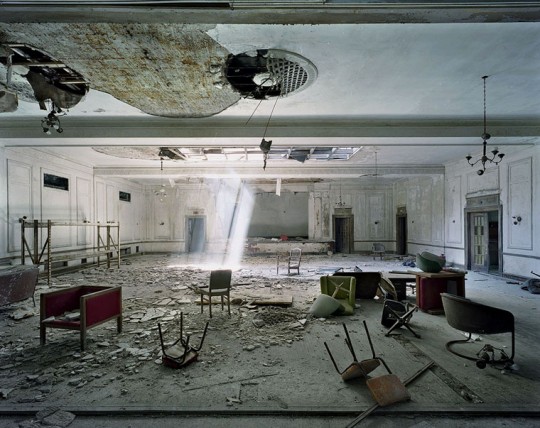
Says the Wall Street Journal:
More than 20% of Detroit’s 139 square miles could go without key municipal services under a new plan being developed for the city, with as few as seven neighborhoods seen as meriting the city’s full resources.
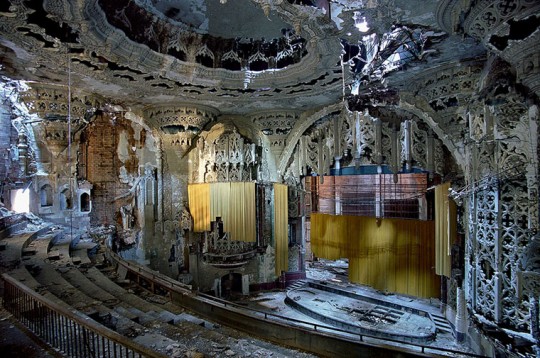
Mr. Bing’s staff wants to concentrate Detroit’s remaining population…. and limited local, state and federal dollars in the most viable swaths of the city, while other sectors could go without such services as garbage pickup, police patrols, road repair and street lights.
And it’s worth remembering that Detroit is still one of the 15 largest cities in the United States by population, bigger than San Francisco, Jacksonville, Boston, Denver and plenty of other major cities. Sure, it’s significantly less dense than those cities, but there are still nearly a million people in its borders.
And while revitalizing Detroit seems daunting, there are groups that are taking on the task. Cityscape Detroit is a nonprofit group devoted to “good urban planning, urban design, historic preservation, architecture, investment, green spaces, mass transit, interesting streetscapes, pedestrianism, human scale development, urbanism, and the ‘built environment’ in Detroit.” The organization is pushing for the idea of public “land banks” to purchase excess land, in the hope of creating public assets in the future.
Detroit Lives! provides another take to the usual gloom and doom. Check out their film, the Farmer and the Philosopher, which discusses long-term options for Detroit:
Perhaps it’s fitting that Detroit must give up on parts of itself in order to save itself. The city’s motto, coined after a devastating fire in 1827, translates from Latin as “We hope for better things; it shall arise from the ashes.”
Photographs in this post by Yves Marchand and Romain Meffre. Thanks to Public Frenemy from the idea. Also, if you know an organization that has ideas about Detroit’s future, please feel free to leave a comment.
Related posts:





2 Responses to “The Shrinking, Adapting City of Detroit”
Leave a Reply
[...] photographs appear to fall in the urban decay genre that has been so popular lately (see Yves Marchand and Romain Meffre’s work as a prime example). But upon closer inspection, you realize the photographs are of diaromas [...]
[...] of just a few generations the car industry all but created the city, suburbanized it, and then left the whole thing to rot. In a pair of larger prints (18 x 24 inches) at the front of the gallery and in a grid of 28 [...]
[...] photographs appear to fall in the urban decay genre that has been so popular lately (see Yves Marchand and Romain Meffre’s work as a prime example). But upon closer inspection, you realize the photographs are of diaromas [...]
[...] of just a few generations the car industry all but created the city, suburbanized it, and then left the whole thing to rot. In a pair of larger prints (18 x 24 inches) at the front of the gallery and in a grid of 28 [...]